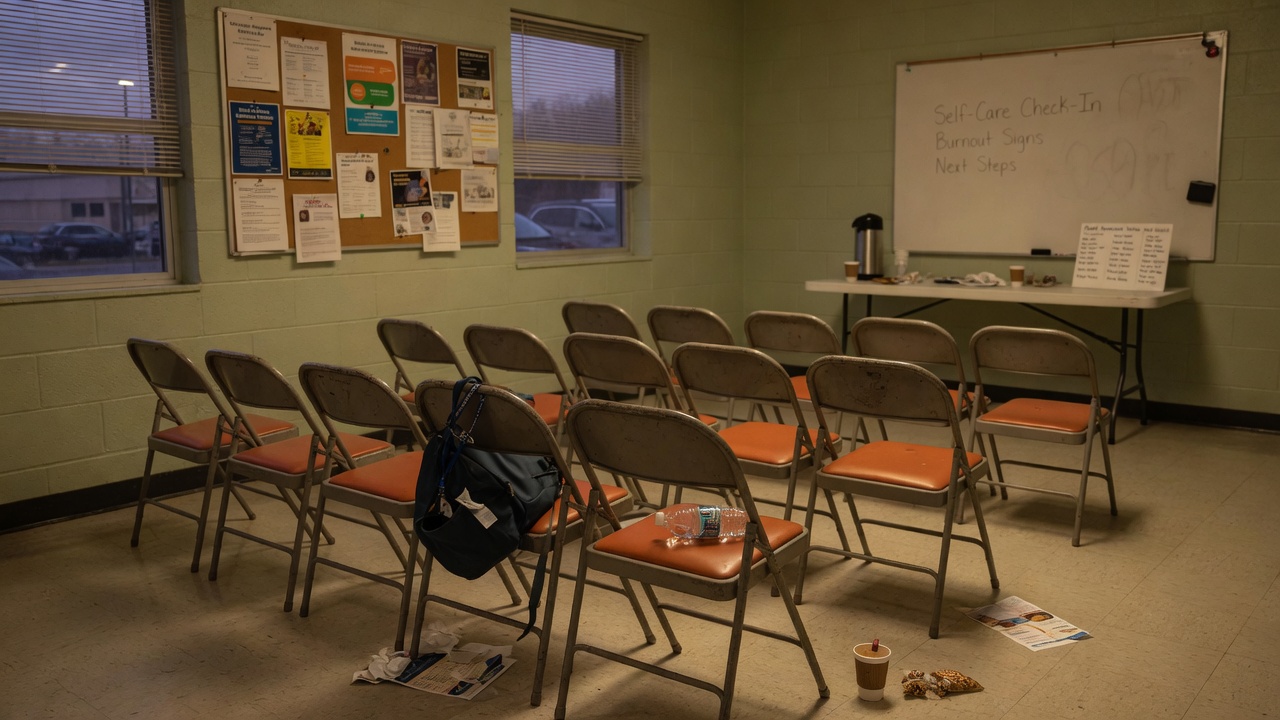

Some of the weariest people I meet are not cynical. They are faithful.
They answer the crisis call. They sit with the family that has nowhere else to go. They fill the gap when the grant is late and the need is early. They love the mission enough to keep showing up — and that love, over time, can become a weight they no longer know how to set down.
If you serve in a North Texas nonprofit, agency, mentoring program, or justice-adjacent ministry, this is for you and for the leaders who care about you. Burnout among front-line staff is not a character flaw. It is often the bill that arrives when compassion outruns care.
What Front-Line Work Actually Carries
Front-line roles absorb more than tasks. They absorb stories. Trauma that is not theirs still enters the room. Moral injury shows up when systems cannot deliver what a person clearly needs. Secondary grief settles in after one more funeral, one more setback, one more young person who disappears from the caseload.
Add thin budgets, high turnover, and the quiet pressure to be endlessly available, and the soul starts to thin out. People stop sleeping well. Prayer becomes hard. Cynicism creeps in as a form of self-protection. Or they double down and work harder — which only deepens the exhaustion.
None of that means the mission was wrong. It means the mission is human work done by humans with limits God designed on purpose.
Burnout Is Not the Same as Laziness
Scripture never mocks the weary servant. Jesus invited the exhausted: “Come to me, all you who are weary and burdened, and I will give you rest” (Matthew 11:28, NIV). Rest is not the enemy of calling. Sometimes rest is how calling survives.
Elijah collapsed under a tree after a great spiritual victory and asked to die (1 Kings 19, NIV). God did not scold him with a productivity lecture. God met him with food, sleep, and a quieter word. That pattern still matters for nonprofit teams: before another strategy session, someone may need bread, rest, and a safe place to admit they are spent.
What Leaders Often Miss
Many agency leaders love their people and still default to fixes that only half-help:
- Another training on self-care that adds homework to an already full week
- Pizza in the break room while caseloads stay impossible
- “We’re a family” language without boundaries that protect real families at home
- Silence about spiritual weight because the organization is “not a church”
I am not against trainings or pizza. I am for honesty. Burnout is rarely cured by information alone. It eases when people are seen, when load is shared, when grief is named, and when someone outside the reporting line can sit with the moral weight without turning it into a performance review.
What Helps on the Ground
In organization chaplaincy, the work often looks ordinary:
- Confidential conversations for staff who cannot process everything in the team meeting
- Debriefs after hard incidents — client death, violence, a volunteer crisis, a public failure
- Prayer when welcomed, without forcing faith on anyone
- Presence for leaders who carry the budget and the people and have nowhere safe to be tired
- A rhythm of care before the crisis, not only after someone resigns
This is not clinical therapy and not HR. It is pastoral care for teams whose daily work is already pastoral in all but name. If your organization needs a simple framework for hard days, the nonprofit crisis debrief path and contract chaplaincy conversations exist for that reason.
A Word to the One Who Is Running on Empty
If you are the staff member reading this between appointments, hear this clearly: your fatigue does not mean you never belonged in this work. It may mean you have loved well without being held well. You are allowed to need care. You are allowed to ask for limits. You are allowed to grieve the people you could not save.
God is not impressed by burnout presented as faithfulness. He is close to the crushed in spirit (Psalm 34:18, NIV). That closeness includes the cubicle, the shelter hallway, the late drive home when you have nothing left to give your own family.
A Word to Directors and Boards
Stewardship is not only funders and outcomes. It is the people who carry your mission in their bodies. Budget for care the way you budget for programs. Build relationships with chaplains and counselors before the next hard season. Make it culturally safe to say, “This week broke me,” without fear of being labeled weak.
If you want a concise overview for agency partners, the free Organization Chaplain Overview for Agencies can start an honest conversation about scope, confidentiality, and what presence looks like beside your existing EAP or benefits.
Closing
Nonprofit front-line work is holy ground. It is also costly ground. Burnout is what happens when cost goes unnamed and care goes optional. You do not have to choose between mission and mercy for the people who deliver the mission. Christ’s way has always held both.
If your team is tired in a way pizza cannot fix, I would be honored to talk — about debrief, contract chaplaincy, or simply a first conversation with no pressure. Presence is part of the work. Your staff deserve some of it too.
From a chaplain’s heart — may those who pour out be poured into.