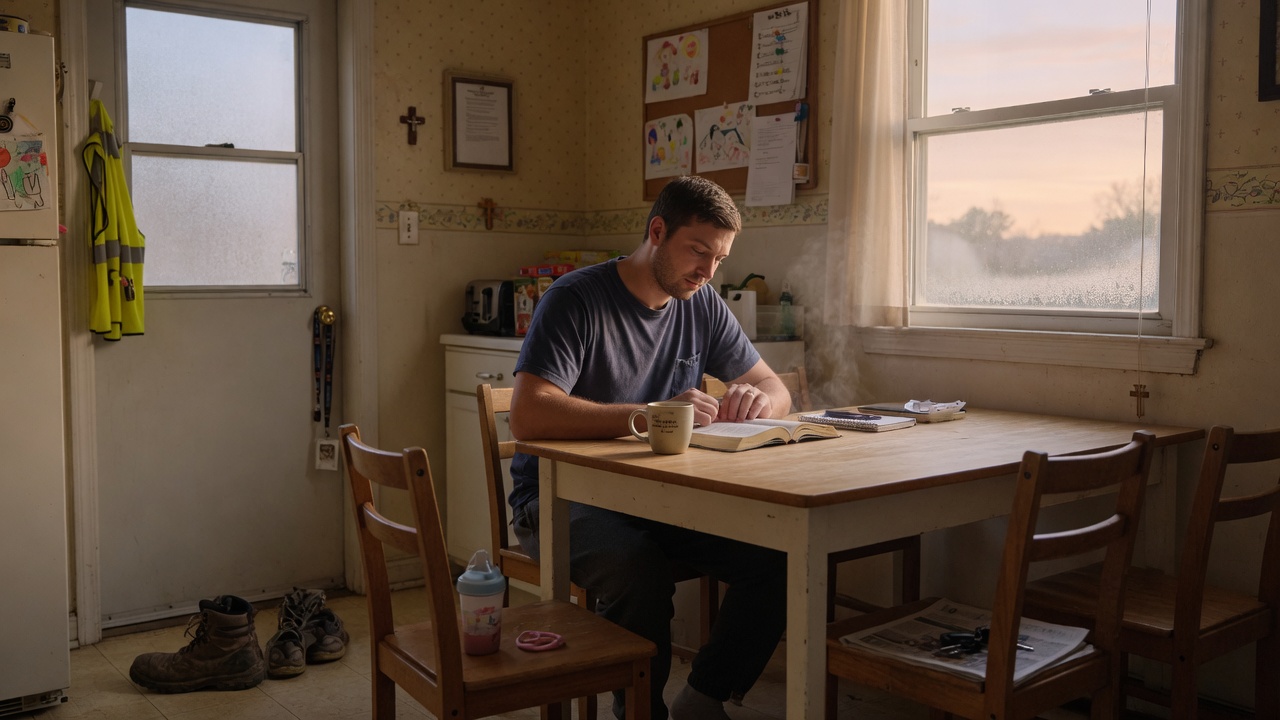

I saw this post and it stopped me.
Women now hold more U.S. payroll jobs than men. It’s only the third time that’s ever happened, and the data suggests this one may stick. Healthcare and care work keep growing. A lot of the old male-dominated sectors are soft. Male labor-force participation is near historic lows. And yes — the “stay-at-home boyfriend” and “stay-at-home husband” numbers are climbing.
People are already laughing, meme-ing, and arguing about it. Some celebrate it as progress. Some treat it like the end of the world. I want to slow down and ask a different question: What does Scripture actually say about the design of men, women, work, and the household?
I’m not writing this as a culture-war take. I’m writing it as a husband, a father of four, a chaplain, and a man who has walked with a lot of families in crisis. The design matters. And when we ignore it, people get hurt — quietly at first, then loudly.
God’s Design Is Not Optional Décor
From the beginning, God put the man in the garden “to work it and take care of it” (Genesis 2:15, NIV). Work is not a curse. It is part of the blessing of being made in the image of a working God. After the fall, that work becomes harder — “By the sweat of your brow you will eat your food” (Genesis 3:19, NIV) — but the calling does not disappear.
Paul is blunt in 1 Timothy 5:8:
“Anyone who does not provide for their relatives, and especially for their own household, has denied the faith and is worse than an unbeliever.” — 1 Timothy 5:8 (NIV)
That verse is not about rigid 1950s gender roles. It is about responsibility. A man who is able-bodied and simply refuses the weight of provision is walking away from something basic to Christian manhood.
The New Testament keeps the same pressure against idleness. Paul told the Thessalonians:
“For even when we were with you, we gave you this rule: ‘The one who is unwilling to work shall not eat.’ … We hear that some among you are idle and disruptive. They are not busy; they are busybodies. Such people we command and urge in the Lord Jesus Christ to settle down and earn the food they eat.” — 2 Thessalonians 3:10–12 (NIV)
Does that mean a woman should never earn more, or that a husband can never stay home for a season of illness, disability, or unique family need? Of course not. Life is complicated. Grace is real. Proverbs 31 shows a woman who is industrious, entrepreneurial, and strong — she “considers a field and buys it” and “her lamp does not go out at night.” The issue is not whether a wife works. The issue is whether men are checking out of the responsibility God gave them.
When large numbers of young men drift into prolonged idleness — video games, endless scrolling, “figuring it out” — while women carry both the paycheck and the emotional load of the home, something is broken. Scripture does not celebrate that arrangement. It warns against it.
This Is Not Just Economics
The jobs numbers are real. Healthcare is female-dominated and growing. Many traditionally male industries have contracted. Education gaps, cultural messaging, and policy choices all play a part. But underneath the data is a heart issue.
We have spent decades telling boys that traditional masculinity is the problem. We have downplayed the beauty of a man who shows up, protects, provides, and leads his home with quiet strength. Scripture holds a different picture. In Ephesians 5, the husband is called to love his wife “just as Christ loved the church and gave himself up for her” (Ephesians 5:25, NIV). That kind of love includes carrying weight — not dominating, but taking responsibility so the household can flourish.
Psalm 128 paints the fruit of that ordered life:
“Blessed are all who fear the Lord, who walk in obedience to him. You will eat the fruit of your labor; blessings and prosperity will be yours. Your wife will be like a fruitful vine within your house; your children will be like olive shoots around your table.” — Psalm 128:1–3 (NIV)
The picture is not of a man checked out while his wife carries everything alone.
Meanwhile, many women are exhausted. They were told they could “have it all,” and a lot of them are discovering that “all” includes carrying the financial future of the household while still being expected to manage most of the relational and domestic load. That is not liberation. That is a heavy load no one was designed to carry alone for decades.
Children notice. Boys especially notice when the men in their world seem optional or absent. Girls notice when the men around them seem passive. The long-term cost is not just economic. It is formational.
A Better Word for Men
If you are a man reading this and you feel the weight of it, hear me: the answer is not shame. Shame rarely produces lasting change. The answer is repentance where needed — and then rising up.
Get a job if you need one. Keep the one you have. Learn a trade. Start something. Carry the weight of provision as far as you are able. Love your wife in a way that makes her feel safe, not like she is the only adult in the house. Be the kind of father whose presence steadies the home. That is not toxic. That is biblical.
If circumstances truly keep you from paid work right now — injury, disability, a season of caring for a sick child — then pour yourself into the work that is available to you at home with excellence and without bitterness. Idleness is still the enemy. Colossians 3:23 still applies: “Whatever you do, work at it with all your heart, as working for the Lord, not for human masters.”
If fatherhood is part of the weight you carry, start with the free handout You Are Not Weak. Scripture is not embarrassed by men who need God. Neither am I.
A Better Word for Women
You are not the problem for working hard and succeeding. Many of you are carrying more than previous generations ever expected. That strength is real. Just don’t let the culture convince you that a husband’s quiet provision or leadership is somehow beneath you or unnecessary. Complementary design is not competition. It is cooperation under Christ.
The Bigger Picture
God’s design for the family is not a political preference. It is the pattern He built into creation for human flourishing. When we treat that pattern as optional, we should not be surprised when the results look disordered.
This moment is a chance for the church to speak clearly and kindly. We do not need more memes. We need more men who take responsibility, more women who are free to flourish without having to become both mother and father, and more households ordered around the One who designed them in the first place.
Jesus is still Lord of the household. He is still able to restore what culture has twisted. And He is still calling men and women to walk in the good works He prepared in advance for us to do — together, not in competition, and not in retreat.
If this landed heavy, sit with it. Talk to the Lord about it. Then, if needed, talk to a trusted brother or sister. The numbers are interesting. The design is better.
If your home is under strain — marriage weight, fatherhood pressure, or a family carrying more than one set of shoulders can hold — I would be honored to walk with you. No sales pitch. Just a chaplain who cares about households ordered under Christ. Start at family support, or reach out directly.
From a chaplain’s heart.